

Table of Contents
- What Makes Survival Gear for Truck Camping Different
- Essential Recovery Gear for Off-Road Emergencies
- Best Truck Bed Storage for Camping Gear
- Truck Camping Emergency Kit Essentials
- Off-Grid Truck Camping Safety Tips
- Weight Limits and Payload Capacity: What Your Truck Can Handle
- Maintenance and Longevity for Truck Camping Gear
- Budget-Tier vs. Pro-Tier: Where to Spend and Where to Save
- Conclusion: Building a Reliable Truck Camping Setup
- Frequently Asked Questions
Last Updated: October 2, 2026
What Makes Survival Gear for Truck Camping Different
The best survival gear for truck camping is chosen around one hard constraint: your truck is both shelter and escape vehicle, so every item has to earn its space.
Truck camping survival gear differs from backpacking gear in three ways: weight matters less than volume, redundancy matters more than ultralight design, and recovery equipment is non-negotiable.
Most gear lists treat truck camping like car camping with a bigger trunk.
Essential Recovery Gear for Off-Road Emergencies
Recovery gear is the foundation of any truck camping emergency kit essentials list. One soft patch of ground or washed-out trail turn can strand you indefinitely.
The core kit: a recovery strap or kinetic rope, two rated tow shackles, traction boards, a collapsible shovel, and a tire repair kit with an air compressor. Each solves a different failure mode.
Recovery Straps, Kinetic Ropes, and Tow Shackles
A recovery strap stretches under load and stores energy, making it gentler on both vehicles. A kinetic rope does the same with more stretch, which helps when the stuck vehicle has limited traction.
Rated hardware matters more than brand. A shackle with a working load limit stamped on it tells you what it can handle; an unrated one tells you nothing.
A tire repair kit and portable air compressor round out the setup. A slow trail puncture shouldn't end a trip when you can plug and reinflate on the spot.
Best Truck Bed Storage for Camping Gear
The best truck bed storage for camping gear keeps weight low, secures loose items, and lets you reach what you need without unloading everything.
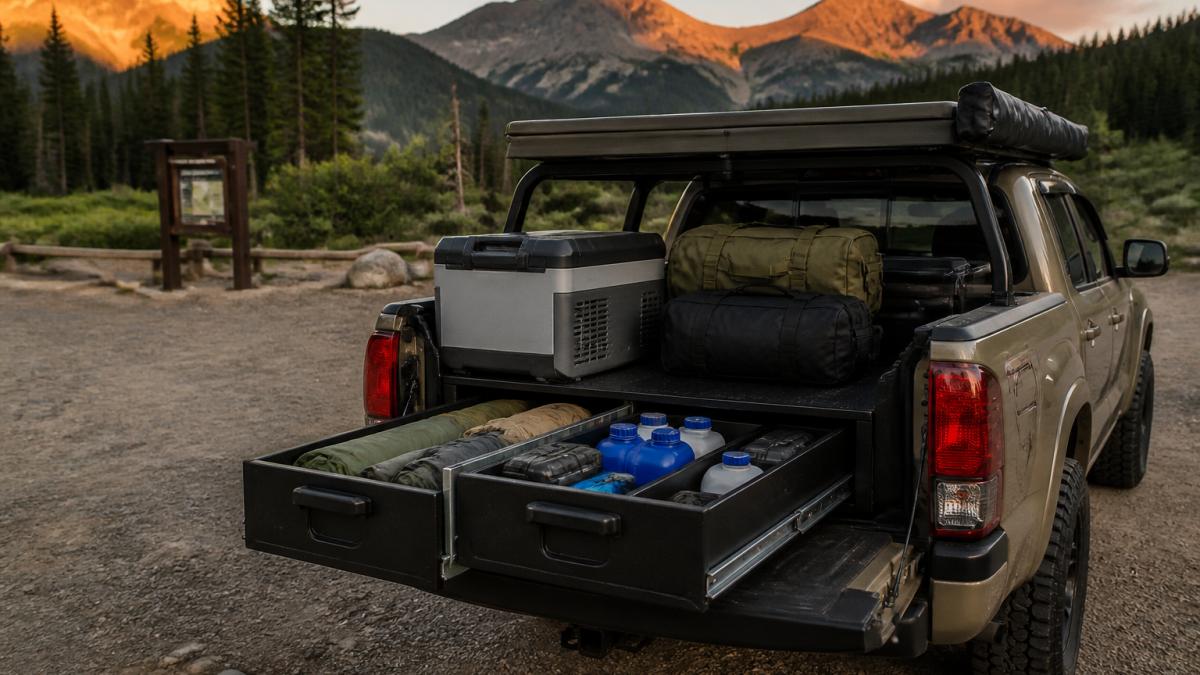
Organization is a safety issue: loose gear becomes a projectile in a sudden stop, and buried recovery gear is useless when you need it.
A practical layout separates gear into three zones:
- Recovery zone: straps, shackles, shovel, and compressor within arm's reach of the tailgate
- Kitchen zone: portable refrigerator, water jug, and cast iron cookware grouped together
- Sleep zone: sleeping bag, camp chair, and emergency blanket packed last so they unload first
A rooftop tent frees bed space but adds weight up high, affecting handling. Weigh your setup before committing.
Truck Camping Emergency Kit Essentials
A truck camping emergency kit essentials setup covers three gaps a recovery kit doesn't: medical care, visibility, and communication. Build it as a separate, always-packed box: if its failure would make the trip an emergency, it stays in the box.
First Aid: Build Around Trauma, Not Band-Aids
A prepackaged first aid kit is a starting point, not a finished kit. Most are stocked for kitchen cuts, not the injuries a truck camper faces: deep lacerations from recovery hardware, burns from stoves and exhaust, and blunt trauma from a fall or roll.
Build the kit in two layers:
- Base layer: adhesive bandages in multiple sizes, gauze rolls, medical tape, antiseptic wipes, nitrile gloves, tweezers, trauma shears, and an irrigation syringe for wound flushing.
- Trauma layer: a tourniquet, a hemostatic dressing, an occlusive chest seal, and a burn gel or burn dressing. These are the items that matter when help is hours away.
Match quantity to group size and trip length: a solo weekend needs a lean kit, a four-person remote week needs multiples of consumables. Check expiration dates annually and replace anything opened.
Lighting: Redundancy by Design
Emergency lighting means more than one headlamp. Plan around a dead battery at dusk with no spare: redundancy matters more than brightness.
A practical lighting loadout:
- One headlamp per person, plus one spare headlamp in the emergency box
- One handheld flashlight with a tail switch for one-handed use
- One lantern for camp tasks and as a backup light source
- Spare batteries in the correct sizes, stored in a sealed bag
Tool Forge Supply ships brands like Fenix and Ledlenser directly from the manufacturer. Look for a low-output mode that stretches runtime to dozens of hours; a dim light all night beats a bright one that dies in two hours.
Communication: The Layer That Replaces Cell Service
Cell coverage ends long before pavement does. The communication layer closes that gap.
- Satellite messenger or personal locator beacon (PLB): works where cell service doesn't. A PLB is a one-way emergency-only device; a satellite messenger adds two-way texting and location sharing. Choose based on whether you want to send "running late" messages or only "send help."
- Offline navigation: a dedicated GPS unit or a phone app with pre-downloaded maps. Download the map tiles for your entire route before you leave, not just the destination.
- A paper backup: a printed topo map and a baseplate compass. Electronics fail; paper doesn't.
The Rest of the Box
An emergency blanket, a fire starter (ferro rod plus waterproof matches), and a multi-tool complete the kit. Pack them where you can reach them without unpacking the truck bed.
Shelf Life and Rotation
Emergency kits fail quietly: batteries corrode, adhesives dry out, medications expire. Set a twice-yearly reminder to open the box, check expiration dates, test every light, and replace anything questionable.
Off-Grid Truck Camping Safety Tips
Off-grid truck camping safety tips come down to preparation before you leave pavement, not improvisation after. The best safety tool is a plan someone else knows about.
The Trip Plan: Your Real Safety Net
Leave a route plan with a contact at home: where you're going, when you expect to arrive, and when you'll check in.
Set a hard check-in deadline and escalation rule: if you don't hear from me by this time, call this number. A plan with no deadline is a plan nobody acts on.
Land-Use Rules and Dispersed Camping Compliance
Where you can legally camp and drive varies enormously by jurisdiction, and the rules are enforced. Before you go:
- Confirm land ownership and rules. National Forest and Bureau of Land Management lands generally allow dispersed camping, but many areas restrict it seasonally or prohibit it near water, trails, or developed sites. National Parks and many state parks restrict camping to designated sites only.
- Check for fire restrictions. Fire bans are common in dry seasons and change week to week. A campfire during a ban can mean a citation and a fine.
- Know your vehicle requirements. Some trails and off-road areas require a permit, a spark-arrestor, or a street-legal registration. Off-highway vehicle (OHV) areas often have their own rules separate from the surrounding public land.
- Respect stay limits. Most dispersed camping areas cap stays at 14 days in one location. Moving camp is part of the deal.
Check the managing agency's website for the specific area before you leave. Rules posted at a trailhead are often out of date.
Mechanical Failure Modes Unique to Truck Camping
Your truck is shelter and escape vehicle, so a mechanical failure is a shelter failure. The failures that strand truck campers most often are predictable:
- Battery drain from accessories. A refrigerator, lights, and a phone charger running off the starting battery will kill it overnight. Run accessories off a separate house battery or power station, and carry a jump starter.
- Tire damage from terrain. Sidewall punctures from sharp rock are the most common trail tire failure and can't be plugged. Carry a full-size spare, not a temporary, and know how to change it on uneven ground.
- Overheating on long climbs. Low-speed, high-load climbing in warm weather stresses the cooling system. Watch the gauge and pull over to cool rather than pushing through.
- Fuel range. Off-grid routes often have no services for long stretches. Keep the tank above half at all times, and know the distance to the next fuel before you commit to a remote road.
Campsite Selection and Setup
Scout your campsite in daylight. Look up before you park: dead branches and rockfall zones are real hazards. Park level so you sleep flat and your refrigerator and stove work, and keep the truck pointed toward your exit route.
Other practices that matter:
- Never camp alone in remote areas if you can avoid it
- Carry more water than you think you need, and know your group's daily consumption
- Test your recovery gear before you need it, not during
- Tell someone your exact campsite coordinates, not just the general area
Tire Pressure: The Most Overlooked Safety Item
Lowering tire pressure for soft terrain improves traction and reduces puncture risk, but you need a gauge and a way to reinflate, where the air compressor from your recovery kit earns its place twice. Air down before the soft section, air up before pavement, and recheck in the morning.
A Note on Solo Travel
Solo truck camping multiplies every risk because there's no one to help with a recovery, repair, or medical issue. If you go alone, carry a satellite messenger, leave a detailed plan, and be more conservative about terrain.
Weight Limits and Payload Capacity: What Your Truck Can Handle
Payload capacity is the maximum weight your truck can carry, including passengers, gear, and accessories.
The math is unforgiving.
Check your payload rating on the driver's door jamb sticker, then weigh your loaded setup at a public scale.
| Gear Category | Typical Weight Range | Best Placement |
|---|---|---|
| Recovery gear | Moderate | Low, near tailgate |
| Storage drawers | Heavy | Over rear axle |
| Rooftop tent | Heavy | Roof, affects handling |
| Water and cooler | Heavy | Low, centered |
| Sleeping and kitchen gear | Light to moderate | Any zone |
Keep heavy items low and centered. That single rule prevents most handling problems.
Maintenance and Longevity for Truck Camping Gear
Gear maintenance is the difference between equipment that lasts a decade and equipment that fails on trip three.
Recovery straps and kinetic ropes need inspection after every use. Look for fraying, cuts, or stiff spots, and retire anything compromised.
Other maintenance habits that pay off:
- Rinse shackles and hardware after mud or salt exposure
- Store sleeping bags uncompressed to preserve loft
- Check tire repair kit sealant expiration dates yearly
- Recharge power stations and test solar panels before each season
- Lubricate multi-tools and folding shovels
Battery-powered gear, including headlamps and power stations, degrades with heat. Store electronics out of direct sun when parked.
Budget-Tier vs. Pro-Tier: Where to Spend and Where to Save
You don't need top-tier gear in every category. Spend on recovery hardware, lighting, and anything rated for load.
Gear that fails catastrophically under load, straps, shackles, winch components, is worth buying once at the higher tier.
That's the framework Tool Forge Supply uses when curating gear: prioritize the items where failure has real consequences, and stay practical everywhere else.
FMCSA commercial vehicle weight and load guidance
Conclusion: Building a Reliable Truck Camping Setup
Building a truck camping setup that works takes more than a shopping list: matching gear to your truck's real payload, keeping recovery equipment accessible, and maintaining everything so it works when it matters.
Tool Forge Supply curates rugged, field-tested gear built for exactly this kind of trip.
Shop Gear at Tool Forge Supply and spend less time setting up camp, and more time out there.
Frequently Asked Questions
What are the must-haves for truck camping?
Start with recovery gear like a kinetic rope and tow shackles, a tire repair kit with an air compressor, and a first aid kit. For comfort, pack a sleeping bag, portable power station, and a headlamp. A truck bed storage system keeps everything organized so you can find gear fast in an emergency. Don't forget a collapsible shovel and traction boards for off-road recovery.
How do you organize survival gear in a truck bed?
Use a drawer storage system or heavy-duty bins to group items by function: recovery gear in one, cooking supplies in another, emergency kit in a third. Keep frequently used items near the tailgate and heavy gear over the rear axle to maintain payload balance. A cargo net or tie-down straps prevent shifting on rough trails. Label bins so anyone can find what they need quickly.
What should be in a vehicle emergency kit for remote areas?
A remote-area kit needs more than a basic roadside set. Include a first aid kit, emergency blanket, fire starter, multi-tool, and a power station for charging devices. Pack extra water, non-perishable food, and a navigation device that works without cell service. A tire repair kit and air compressor are critical since help may be hours away. Store everything in a waterproof container.
Can I legally sit in the bed of a truck?
Laws vary by state, but most require passengers in a truck bed to be seated on a permanent fixture and wear a seatbelt if one is available. Some states prohibit riding in the bed entirely on highways. Check your state's vehicle code before allowing anyone to ride in the back. For camping, it's safer to keep passengers in the cab and use the bed only for gear.